Découvrir le TCF Canada · leçon 7 sur 7 · 22 min
Connectez-vous pour suivre votre progression
Espace de révisionObjectif
À la fin de cette leçon, tu sauras qui corrige, comment chaque épreuve est notée, et ce que le correcteur cherche vraiment.
La correction en vrai
Avant les astuces, comprends qui corrige et comment.
Glossaire
1 Qui corrige, et où
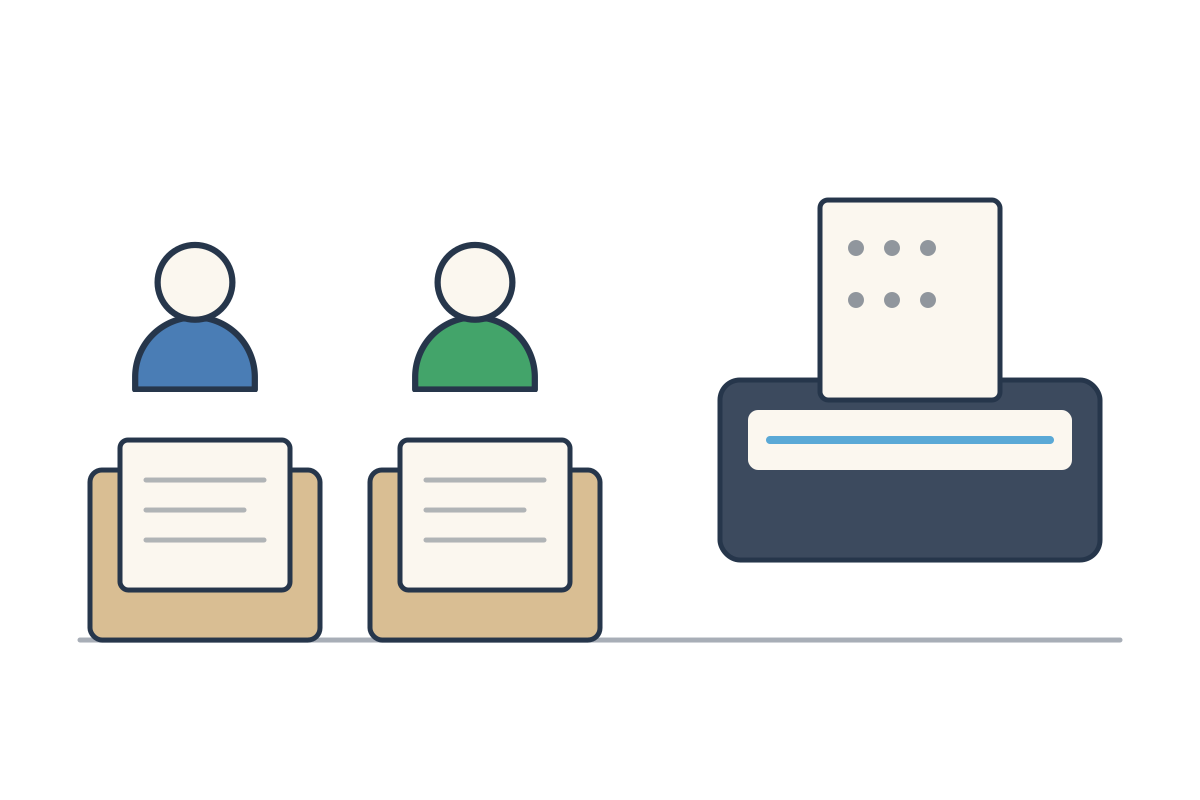
Toutes les copies partent au même endroit : France Éducation international. Rien n’est corrigé dans ton centre.
Les QCM sont corrigés par lecture optique, une machine supervisée par une équipe. Écrire et Parler sont corrigés par des humains formés, deux fois.
2 Deux familles d’exercices
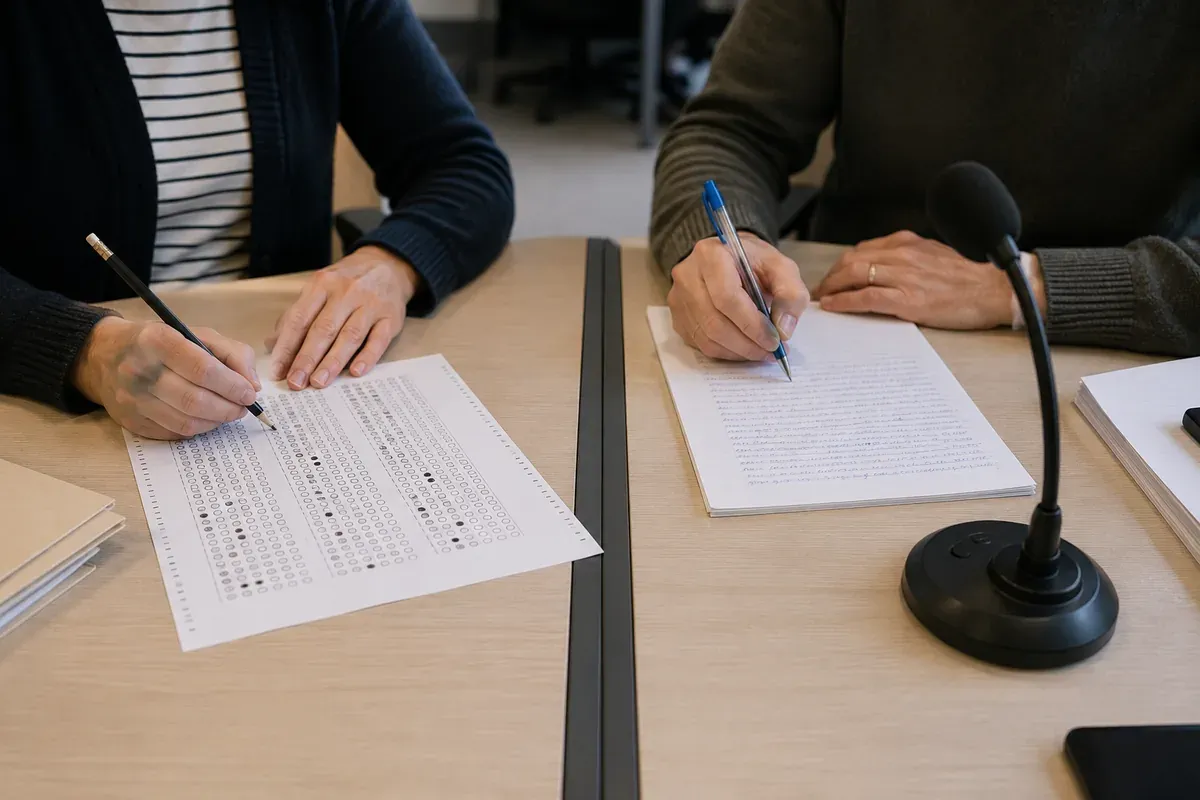
Il y a deux familles. Les QCM (Écouter, Lire) : tu coches. Les tâches (Écrire, Parler) : tu produis toi-même.
Ces deux familles ne sont pas notées de la même façon. C’est normal : elles ne mesurent pas la même chose.
3 Ce que la correction mesure vraiment
Aux QCM, on mesure si tu as repéré la bonne information. Pas si tu as reconnu un mot.
À Écrire et Parler, on mesure ton français : tes mots, tes phrases, tes idées, dans une vraie situation, pour un vrai destinataire.

4 Les QCM : comment les points arrivent
Seules les bonnes réponses comptent. Une bonne réponse rapporte des points selon la difficulté de la question. Une réponse fausse ou vide = 0 point. Il n’y a jamais de point négatif.
Un barème transforme ensuite tes bonnes réponses en un score de 100 à 699. Ce n’est pas une moyenne que tu pourrais calculer toi-même.

5 Écrire et Parler : la grille /20
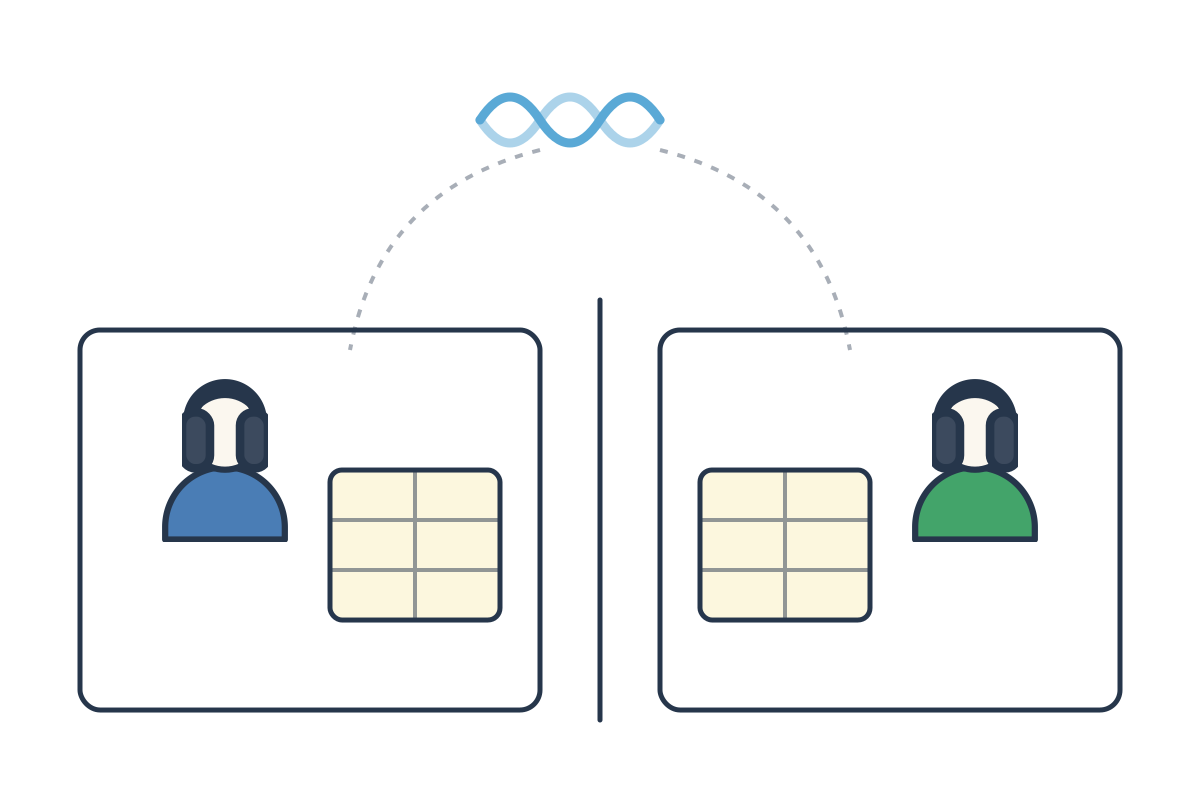
Deux correcteurs formés notent chacun de leur côté, sans savoir ce que l’autre a mis. Chacun donne à chaque tâche un niveau, de « A1 non atteint » à « C2 ». Une règle de calcul donne ta note /20 et ton niveau final.
Ils regardent 3 critères : linguistique (lexique, grammaire, orthographe), pragmatique (cohérence, organisation des idées), sociolinguistique (adaptation au destinataire).
6 Le secret du concepteur
Les garde-fous ne sont pas là pour te punir. Ils protègent ce que le test mesure.
Si tu recopies une phrase du sujet, le correcteur ne voit plus ton français : il voit celui du sujet. Si tu récites un texte appris par cœur, il ne voit pas ton niveau réel : c’est traité comme une fraude. C’est pour ça que ces deux erreurs font chuter la note à « A1 non atteint », même si le texte est beau.
Même logique aux QCM : s’il n’y a pas de point négatif, c’est parce qu’on veut mesurer ce que tu sais, pas ta prudence. Laisser vide ne te protège de rien : ça vaut 0, exactement comme une erreur.

Éviter les garde-fous, à l’écrit comme à l’oral
Recopier le sujet, ou écrire avec tes mots
Tu recopies une belle phrase du sujet dans ta réponse. Le correcteur ne voit plus ton français : garde-fou, note « A1 non atteint ».
Tu dis la même idée avec tes mots. Le correcteur voit ton vrai niveau, et ta note reflète ce que tu sais faire.
Exemple
Sofia écrit un beau texte, mais elle recopie une phrase du sujet. Le garde-fou s’applique. Sa note chute à « A1 non atteint ». La leçon : écris avec tes propres mots.
Tarek ne sait pas une réponse au QCM. Au lieu de laisser vide, il coche un choix. Il a une chance d’avoir juste, et il ne perd rien s’il a faux.
À retenir
Pour aller plus loin
Petit test
Les QCM sont corrigés par lecture optique : une machine lit les cases cochées, supervisée par une équipe. Il n’y a pas d’intelligence artificielle qui juge le sens.
Non : une mauvaise réponse ou une réponse vide vaut 0. Il n’y a jamais de point négatif. Seules les bonnes réponses comptent.
Recopier le sujet déclenche un garde-fou : ta copie peut être évaluée « A1 non atteint ». Le correcteur veut voir ton français, pas celui du sujet.
Deux correcteurs formés notent ta copie de manière indépendante, sans connaître la note de l’autre. En cas de gros écart, une troisième correction est faite.
Une récitation ne montre pas ton niveau réel : elle peut être considérée comme une fraude, et l’épreuve évaluée « A1 non atteint ». Parle avec tes propres mots.
Objective
By the end of this lesson, you will know who marks the exam, how each part is scored, and what the marker is really looking for.
The real marking
Before the tips, understand who marks and how.
Glossary
1 Who marks, and where
All papers go to the same place: France Éducation international. Nothing is marked at your centre.
The MCQs are marked by optical reading, a machine supervised by a team. Writing and Speaking are marked by trained humans, twice.
2 Two families of exercises
There are two families. The MCQs (Listening, Reading): you tick. The tasks (Writing, Speaking): you produce yourself.
These two families are not marked the same way. That is normal: they do not measure the same thing.
3 What the marking really measures
In the MCQs, we measure whether you spotted the right information. Not whether you recognized a word.
In Writing and Speaking, we measure your French: your words, your sentences, your ideas, in a real situation, for a real reader.
4 The MCQs: how the points arrive
Only correct answers count. A correct answer earns points based on the difficulty of the question. A wrong or blank answer = 0 point. There is never a negative point.
A scale then turns your correct answers into a score from 100 to 699. It is not an average you could work out yourself.
5 Writing and Speaking: the grid out of 20
Two trained markers score independently, without knowing what the other gave. Each gives each task a level, from “A1 not reached” to “C2”. A calculation rule gives your mark out of 20 and your final level.
They look at 3 criteria: linguistic (vocabulary, grammar, spelling), pragmatic (coherence, organization of ideas), sociolinguistic (fit to the reader).
6 The designer’s secret
The safeguards are not there to punish you. They protect what the test measures.
If you copy a sentence from the prompt, the marker no longer sees your French: they see the prompt’s. If you recite a memorized text, they do not see your real level: it is treated as fraud. That is why these two mistakes drop the mark to “A1 not reached”, even if the text is beautiful.
Same logic in the MCQs: if there is no negative point, it is because we want to measure what you know, not your caution. Leaving a blank protects nothing: it is worth 0, exactly like a mistake.
Avoiding the safeguards, in writing and in speaking
Copying the prompt, or writing with your words
You copy a nice sentence from the prompt into your answer. The marker no longer sees your French: safeguard, mark “A1 not reached”.
You say the same idea with your words. The marker sees your real level, and your mark reflects what you can do.
Example
Sofia writes a beautiful text, but she copies a sentence from the prompt. The safeguard applies. Her mark drops to “A1 not reached”. The lesson: write with your own words.
Tarek does not know an MCQ answer. Instead of leaving it blank, he ticks a choice. He has a chance of being right, and he loses nothing if he is wrong.
Key points
Go further
Quick test
The MCQs are marked by optical reading: a machine reads the ticked boxes, supervised by a team. There is no artificial intelligence judging the meaning.
No: a wrong or blank answer is worth 0. There is never a negative point. Only correct answers count.
Copying the prompt triggers a safeguard: your paper can be assessed “A1 not reached”. The marker wants to see your French, not the prompt’s.
Two trained markers score your paper independently, without knowing the other’s mark. If there is a big gap, a third marking is done.
A recitation does not show your real level: it can be treated as fraud, and the part assessed “A1 not reached”. Speak with your own words.
 Certavia